Buying Acreage in Douglas County: The Ultimate Rural Homebuyer Checklist
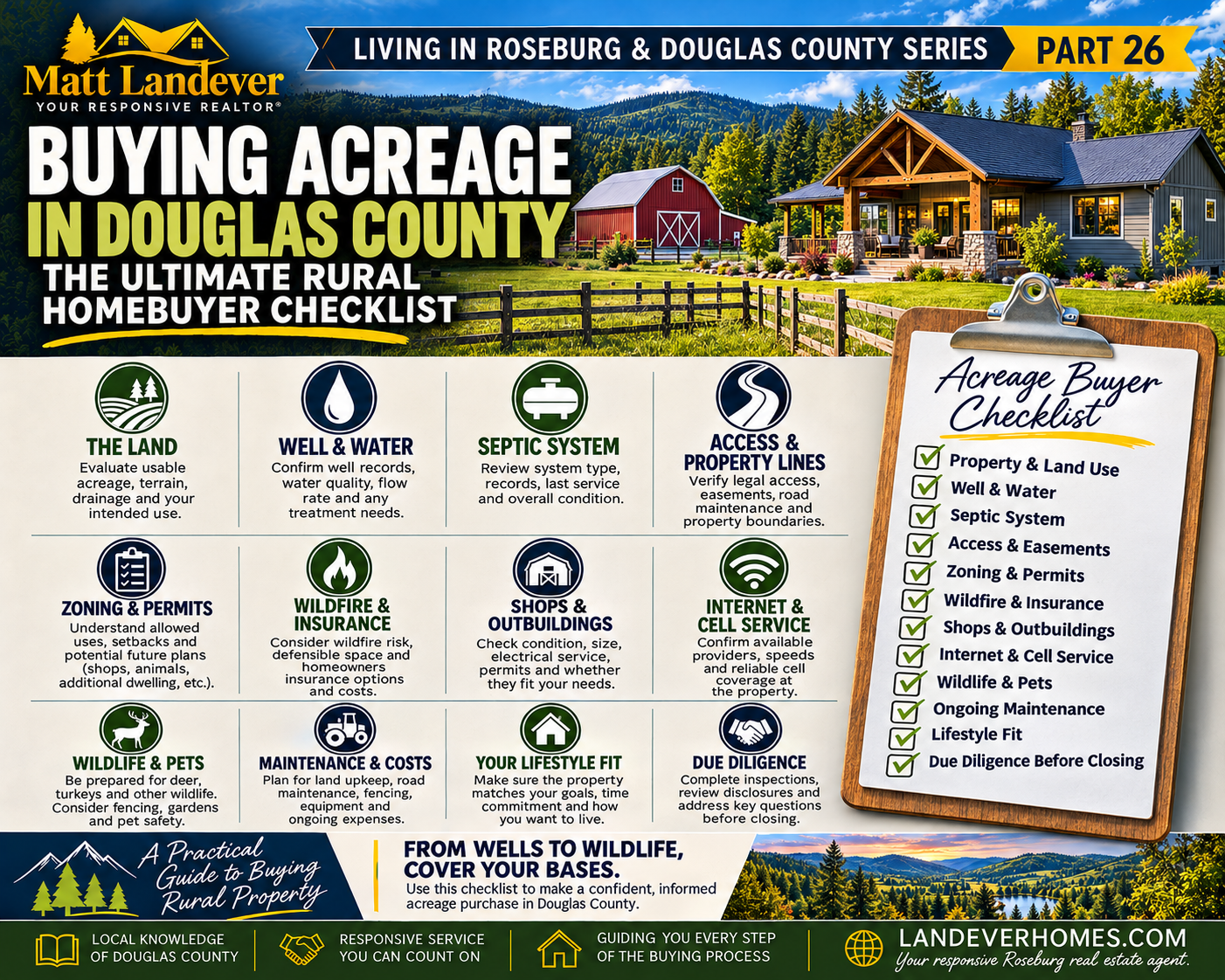
Buying acreage in Douglas County can be an exciting opportunity.
Whether you're looking for five acres outside Roseburg, a wooded retreat near Glide, or a property with a shop and open pasture around Sutherlin, rural real estate offers possibilities that are difficult to find with a traditional home in town.
More privacy. More space. Room for hobbies, animals, gardening, and enjoying the outdoors.
But buying acreage also means looking beyond the house itself.
Over the past several articles in our Living in Roseburg & Douglas County Series, we've explored the many things buyers should understand before purchasing rural property.
Now we're bringing those topics together into one practical checklist.
If you're considering buying acreage in Douglas County, these are the questions I'd encourage you to ask before making your final decision.
1. Understand the Land You're Buying
The first thing to consider is the property itself.
Five acres of flat, usable pasture can offer a very different experience from five acres of steep, wooded hillside.
Neither is necessarily better.
It depends on how you want to use the land.
Your checklist:
How much of the acreage is usable for my intended purposes?
Is the property mostly level, sloped, wooded, or open?
Are there drainage concerns or areas that collect standing water?
Are there creeks, seasonal waterways, or other natural features?
Does the property offer the privacy and space I'm looking for?
My advice: Don't focus entirely on the acreage number. Think about how the land actually functions.
2. Understand the Well and Water Supply
Many rural properties throughout Douglas County rely on private wells rather than municipal water.
If you're purchasing a home with a well, understanding its condition and performance is important.
Your checklist:
Does the property have a private well or another water source?
Are well records available?
Has the water been tested?
Is there information about the well's production or flow rate?
What equipment serves the well, including pumps and pressure tanks?
Is water treatment equipment installed or needed?
Water quality and water quantity are two different things.
A well may produce plenty of water but require treatment, or provide good-quality water while having limited production.
Understanding both can help you make a more informed decision.
3. Evaluate the Septic System
If the home isn't connected to a municipal sewer system, it may have a private septic system.
These systems are common on rural properties, but they're also something you'll want to understand before purchasing.
Your checklist:
What type of septic system serves the property?
Are installation or permit records available?
When was the system last inspected or pumped?
Has a qualified professional evaluated its condition?
Where are the tank and drain field located?
Are there known problems or past repairs?
Remember that the drain field is just as important as the tank.
Knowing its location can also help you plan future landscaping, fencing, or construction.
4. Verify Property Lines and Legal Access
One of the most important differences between buying acreage and a traditional residential property can be understanding boundaries and access.
A fence line isn't necessarily the legal property line.
And a driveway that's been used for years doesn't automatically tell you everything about the legal right to access the property.
Your checklist:
Are the property boundaries clearly understood?
Is a survey available, or should one be considered?
Does the property have documented legal access?
Are there recorded easements affecting the property?
Is the driveway or access road private or publicly maintained?
Is there a road maintenance agreement?
Are there any shared access arrangements?
My advice: Physical access and legal access aren't always the same thing. Don't assume they're interchangeable.
5. Research Zoning and Permits
Before buying acreage, think about what you want to do with it.
Do you want to build a large shop?
Keep livestock?
Add another dwelling?
Operate a business?
Divide the property someday?
Not every rural property allows the same uses.
Your checklist:
What is the property's zoning designation?
Does the zoning allow my intended uses?
Are there setbacks or development restrictions?
Are existing structures properly permitted or approved for their current uses?
Could I add a shop or other structure if desired?
If important to my plans, is another dwelling or land division possible?
For properties in unincorporated Douglas County, the county Planning Department is an important resource for investigating zoning and land-use questions.
Don't rely solely on a listing description when future development is a major reason for your purchase.
6. Consider Wildfire Preparedness and Insurance
Wildfire preparedness is an important consideration for many rural properties in Southern Oregon.
The surrounding vegetation, terrain, construction, and emergency access can all influence the property's risk.
Your checklist:
Is vegetation maintained around the home?
Are trees and shrubs managed near structures?
Are the roof and gutters reasonably clear of debris?
Can emergency vehicles access the property?
Are the driveway, gates, and address suitable for emergency access?
Have I obtained a homeowners insurance quote?
Do I understand any coverage limitations or additional insurance needs?
My advice: Investigate insurance early. Don't wait until the final days before closing to find out what coverage may cost.
7. Inspect Shops, Barns, and Outbuildings
For many acreage buyers, the outbuildings are just as important as the home.
A large shop, detached garage, barn, or equipment building can be a major benefit.
But these structures deserve their own evaluation.
Your checklist:
Does the building fit my intended use?
Are the doors tall and wide enough for my equipment or vehicles?
What is the condition of the roof, siding, framing, and foundation?
Does the building have electricity?
Is the electrical service adequate for my needs?
Is water available if needed?
Can I easily access the building with a trailer, RV, or other equipment?
Are available permit records consistent with how the building is being used?
A large shop isn't necessarily a better shop.
The right building is one that actually works for your plans.
8. Check Internet and Cell Service
This is particularly important for buyers relocating from larger cities or working remotely.
Internet and cellular service can vary significantly between rural properties.
Your checklist:
Which internet providers serve the specific address?
What download and upload speeds are available?
Is the connection suitable for working remotely or video calls?
Have I tested cell service at the property?
Does my preferred cellular carrier work reliably?
Are alternative internet options available?
Will I need service in a detached shop or other building?
If reliable internet is essential to your work, treat it as a requirement rather than an optional convenience.
9. Think About Wildlife and Pets
Living closer to nature is one of the biggest attractions of rural Douglas County.
Deer, wild turkeys, and other wildlife can be part of the experience.
But buyers should also consider how wildlife may affect gardens, pets, and daily life.
Your checklist:
Is fencing needed for pets or animals?
Would I need to protect a garden or orchard?
Are garbage and animal feed storage areas secure?
Does the surrounding environment fit my comfort level?
Are there nearby roads, livestock, or other considerations for pets?
For many people, sharing the landscape with wildlife is one of the best parts of acreage living.
A little planning can make that experience more enjoyable.
10. Budget for Rural Property Maintenance
The mortgage payment isn't the only cost of owning acreage.
Rural properties may have additional maintenance responsibilities that aren't typical of homes in town.
Your checklist:
Have I budgeted for well and septic maintenance?
Will I be responsible for maintaining a private road or driveway?
How much mowing, brush clearing, or tree work will be needed?
Will I need to purchase equipment?
What fencing or gate repairs may be necessary?
What are the estimated insurance and utility costs?
Have I considered maintenance for shops and other outbuildings?
Do I have funds available for unexpected repairs?
Acreage doesn't automatically mean higher expenses.
But understanding the property's systems and maintenance needs helps you create a more realistic budget.
11. Consider Your Lifestyle, Not Just the Property
This might be the most important question of all.
Does the property actually fit how you want to live?
A beautiful home on twenty acres might sound perfect.
But if you don't enjoy maintaining land, a smaller parcel may be a better choice.
A wooded property might offer incredible privacy, while open pasture may be better suited to gardening or livestock.
There's no universally perfect acreage property.
Your checklist:
Does the property offer the privacy I want?
Is the commute or distance from town comfortable?
Am I prepared for the maintenance involved?
Does the land support my hobbies or long-term goals?
Will the property still fit my needs several years from now?
The goal isn't simply to buy more land.
It's to buy the right land.
12. Complete Your Due Diligence Before Closing
When buying rural property, it's important to give yourself the opportunity to investigate the features that matter to your purchase.
Depending on the property, that may involve inspections, document reviews, conversations with utility providers, and questions for county departments or other professionals.
Your final checklist:
Review the available property disclosures.
Arrange appropriate home and property inspections.
Investigate well and septic systems.
Review available title information and recorded easements.
Verify zoning and important future-use questions.
Obtain homeowners insurance information.
Confirm internet and cellular options.
Evaluate outbuildings and property maintenance needs.
Address significant questions before the applicable contingency deadlines.
Not every property requires exactly the same investigations.
The important thing is identifying which issues matter to your purchase and making sure you have enough information to make a confident decision.
Final Thoughts
Buying acreage in Douglas County can open the door to an incredible lifestyle.
More space.
More privacy.
Room for hobbies, animals, gardens, and the things you enjoy.
But rural property is about much more than the house and the number of acres.
Wells, septic systems, legal access, zoning, outbuildings, insurance, and maintenance all contribute to whether a property is the right fit.
That's why I encourage buyers to approach acreage with both excitement and a clear understanding of what they're purchasing.
The best rural property isn't necessarily the one with the most land. It's the one that fits your lifestyle, your plans, and your budget.
If you're considering buying acreage around Roseburg, Sutherlin, Glide, Oakland, or elsewhere in Douglas County, I'd be happy to help you explore your options and work through the questions that matter most.
My goal is to help you make an informed decision and feel confident about the property you're purchasing.
Matt Landever
Your Responsive Douglas County Real Estate Agent
LANDEVERHOMES.COM
Check out this article next