Understanding Property Lines, Easements & Access: What Rural Homebuyers Should Know
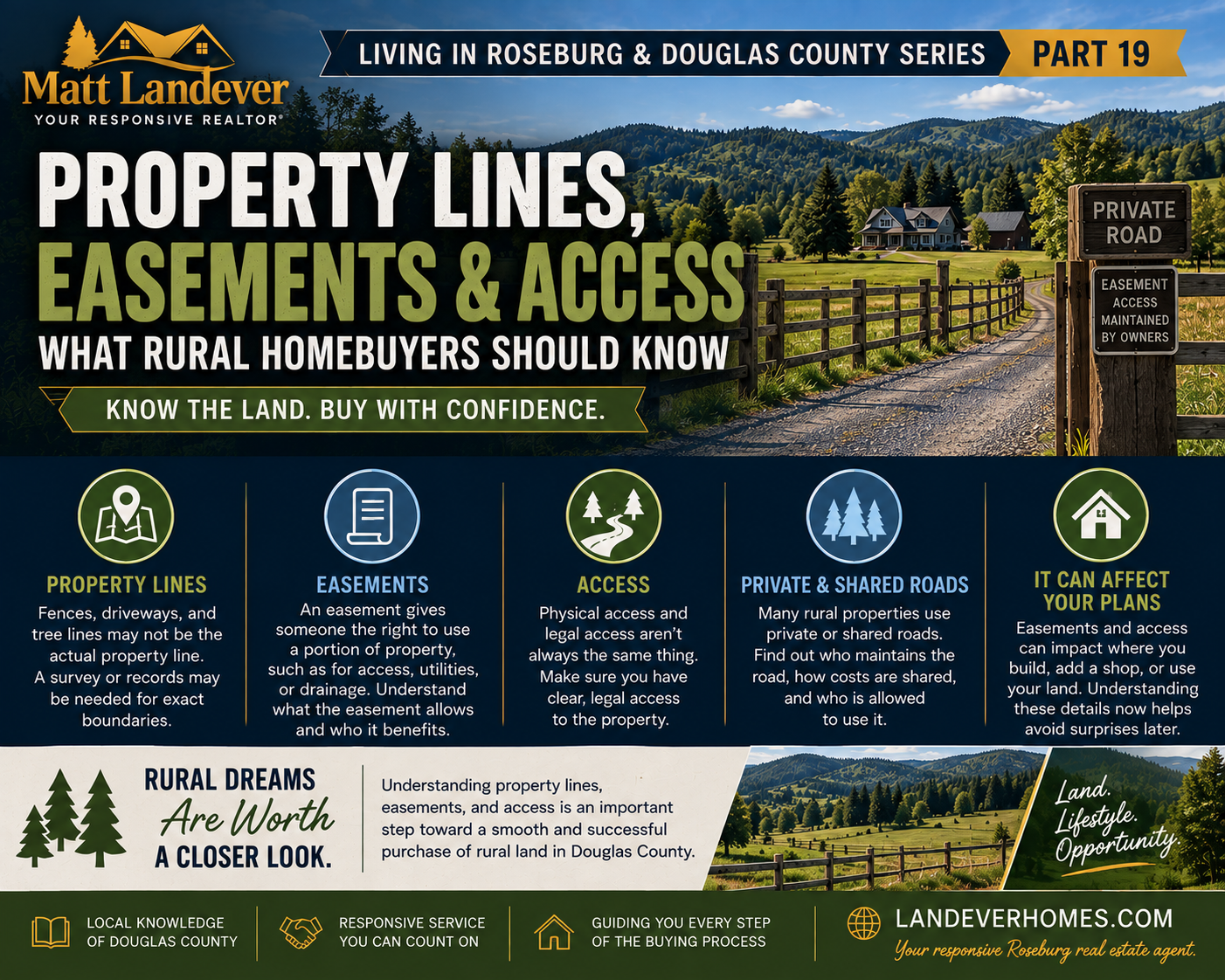
When you're looking at a rural property in Douglas County, it's easy to focus on the house, acreage, shop, views, and privacy.
But there's another question that's just as important:
How do you legally get to the property, and exactly what land are you buying?
Property boundaries, easements, and access can be more complicated with rural properties than with a home in a traditional neighborhood.
You don't need to become an expert in property law to buy acreage. But understanding a few basic concepts can help you know what questions to ask before purchasing.
Property Lines Aren't Always Where You Think They Are
A fence, driveway, tree line, or mowed area may look like an obvious property boundary.
That doesn't necessarily mean it is.
Fences may have been installed inside or outside the actual property line. A driveway may cross another parcel. Even structures that have existed for years aren't necessarily proof of where a legal boundary lies.
Maps and online property information can be useful for getting a general idea of a parcel, but buyers shouldn't automatically treat them as a precise survey.
If the exact location of a property line is important to your plans, additional investigation may be appropriate.
What Is an Easement?
An easement generally gives someone the right to use a portion of property for a particular purpose without owning that portion of the land.
One of the most common examples on rural property is an access easement.
For example, your driveway might cross a neighbor's property before reaching yours. A recorded easement may provide the legal right to use that route.
Easements can also exist for utilities, roads, drainage, and other purposes.
The important question isn't simply whether an easement exists. It's understanding what the easement allows and who it benefits or affects.
Physical Access and Legal Access Aren't Necessarily the Same Thing
This is one of the biggest concepts I want acreage buyers to understand.
You may drive down a perfectly maintained road directly to a house.
That's physical access.
But buyers should also determine what rights exist to use that road.
That's legal access.
The fact that a driveway has been used for years doesn't, by itself, tell you everything about the underlying legal rights.
That's why access is something worth investigating during the purchase process rather than simply assuming everything is fine because you were able to drive to the house.
Private and Shared Roads
Rural properties are frequently accessed by roads that aren't maintained by a city or county.
Sometimes the road belongs entirely to one property. Other times several neighboring properties share it.
That can lead to practical questions such as:
Who maintains the road?
Who pays for gravel or repairs?
How are larger expenses divided?
Is there a written road maintenance agreement?
Who is allowed to use the road?
A shared road isn't necessarily a negative. Plenty of rural homeowners use them without problems.
You simply want to understand the arrangement you're buying into.
Easements Can Affect How You Use Your Property
Access isn't the only reason easements matter.
Imagine finding the perfect location for a future shop, only to discover that a utility easement crosses that portion of the property.
Or perhaps another property has access rights across part of your acreage.
These things don't automatically make the property undesirable, but they can affect your plans.
That's why it's important to consider not only what the property looks like today, but also how you hope to use it in the future.
What Should Buyers Look At?
When purchasing rural property, there may be several sources of information worth reviewing depending on the property.
These can include:
- Preliminary title information
- Recorded easements
- Surveys when available
- Parcel maps
- Road agreements
- Property disclosures
- Other recorded documents affecting the property
Some situations are straightforward. Others may warrant additional review by a surveyor, title company, attorney, county department, or another qualified professional.
My role is to help identify the questions that need to be asked and make sure important issues aren't simply overlooked.
Don't Let This Scare You Away From Acreage
Like wells and septic systems, easements and private roads can sound complicated when you've never dealt with them before.
But they're common features of rural real estate.
The goal isn't necessarily to find acreage with no easements whatsoever.
The goal is to understand what exists, how it affects the property, and whether you're comfortable with it before you buy.
Final Thoughts
A beautiful house and ten acres may catch your attention, but some of the most important details about a rural property aren't visible during a showing.
Knowing where the boundaries are, how the property is accessed, and what rights other people may have can be an important part of your due diligence.
If you're considering acreage in Roseburg or elsewhere in Douglas County, I'll help you research the property, review the available information, and identify questions that should be answered before you move forward.
Check out this article next