If you're buying a home with a private well in Douglas County, one of the most important questions is simple:
Is the water safe to drink?
In Part 16 of this series, we covered the basics of private wells and what it means to own a home that isn't connected to a municipal water system. Now let's take a closer look at the water itself.
For buyers who have always had city water, well water testing may be completely unfamiliar. Fortunately, the basic concept is fairly straightforward.
A water sample is collected and analyzed by a laboratory for specific contaminants. The results can give you valuable information about the water before you purchase the property.
Why Test Well Water When Buying a Home?
With a public water system, the water supplier is responsible for monitoring water quality.
A private well is different. Responsibility for the water generally falls on the property owner.
That makes water testing an important part of evaluating a rural property.
A test can identify certain contaminants that aren't necessarily something you would notice simply by looking at, smelling, or tasting the water.
Clear water doesn't automatically mean everything is okay.
What Do Buyers Commonly Test For?
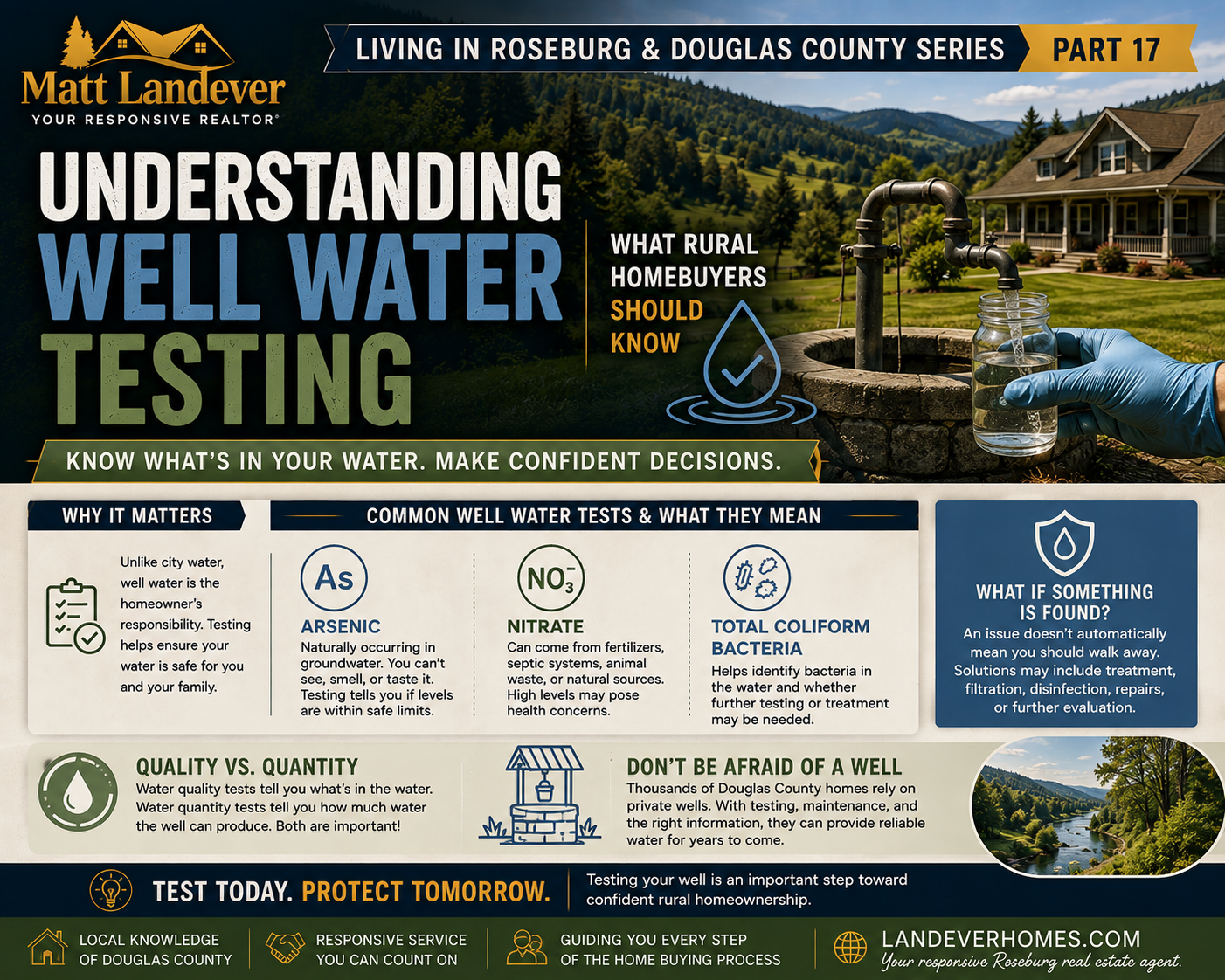
When I'm working with buyers on properties with private wells, three of the most important things we commonly discuss testing for are:
- Arsenic
- Nitrate
- Total coliform bacteria
Each test tells us something different about the water.
Let's look at them individually.
Arsenic
Arsenic is a naturally occurring element that can be present in groundwater.
You generally can't determine whether arsenic is present by looking at or tasting the water, which is why laboratory testing is important.
If elevated levels are discovered, that doesn't necessarily mean the property can't be purchased. Depending on the circumstances, treatment systems may be available.
The important thing is knowing what you're dealing with before making a decision.
Nitrate
Nitrate can enter groundwater from several sources, including fertilizers, septic systems, animal waste, and naturally occurring processes.
Higher nitrate levels can present health concerns, making this another important part of evaluating drinking water from a private well.
Again, testing gives buyers information they simply wouldn't have otherwise.
Total Coliform Bacteria
Coliform bacteria are commonly found throughout the environment.
Testing for total coliform bacteria helps identify whether bacteria are present in the water and whether additional investigation or treatment may be appropriate.
A positive result doesn't automatically tell you exactly where the problem originated. It may mean additional testing or evaluation is needed.
What Happens If a Water Test Finds Something?
This is where buyers sometimes become nervous.
An unfavorable result doesn't automatically mean you need to walk away from the property.
The next step depends on what was discovered and at what concentration.
Possible solutions could include treatment, filtration, disinfection, repairs to the well system, additional testing, or further evaluation by a qualified professional.
The important part is having the information while you're still evaluating the property.
Water Quality and Water Quantity Are Different
This distinction is especially important for acreage buyers.
A water quality test tells you about what is in the water.
It doesn't necessarily tell you how much water the well can produce.
Those are two different questions.
A property could have excellent water quality but limited production. Likewise, a productive well could have a water-quality issue that requires treatment.
When evaluating a rural property, both may be important depending on the property and your needs.
Don't Be Afraid of a Home With a Well
For someone who has always lived with municipal water, all of this can make private wells sound complicated.
They really don't have to be.
Thousands of rural properties rely on private wells. The goal isn't to find a well that never requires attention. It's to understand the system you're purchasing and gather enough information to make an informed decision.
That's one of the reasons proper due diligence is so important when purchasing rural property.
Final Thoughts
A beautiful home on several acres can look perfect during a showing, but some of the most important information about a rural property isn't visible.
Water is a perfect example.
Testing the well water can give you a much clearer understanding of the property and help you make your purchase with confidence.
If you're considering an acreage or rural home in Roseburg or elsewhere in Douglas County, I can help you understand the questions to ask and guide you through the different pieces of the rural home-buying process.
Check out this article next