Wildfire Safety, Defensible Space & Insurance: What Rural Homebuyers Should Know
Living on acreage in Douglas County can mean more privacy, beautiful wooded surroundings, and room to spread out.
But when you're considering a rural property in Southern Oregon, wildfire preparedness is another part of the picture.
That doesn't mean every rural home is facing the same level of risk. Properties can be very different depending on their location, vegetation, terrain, access, construction, and surrounding land.
The goal isn't to be afraid of rural living.
It's to understand the property you're buying and know what questions to ask.
What Is Defensible Space?
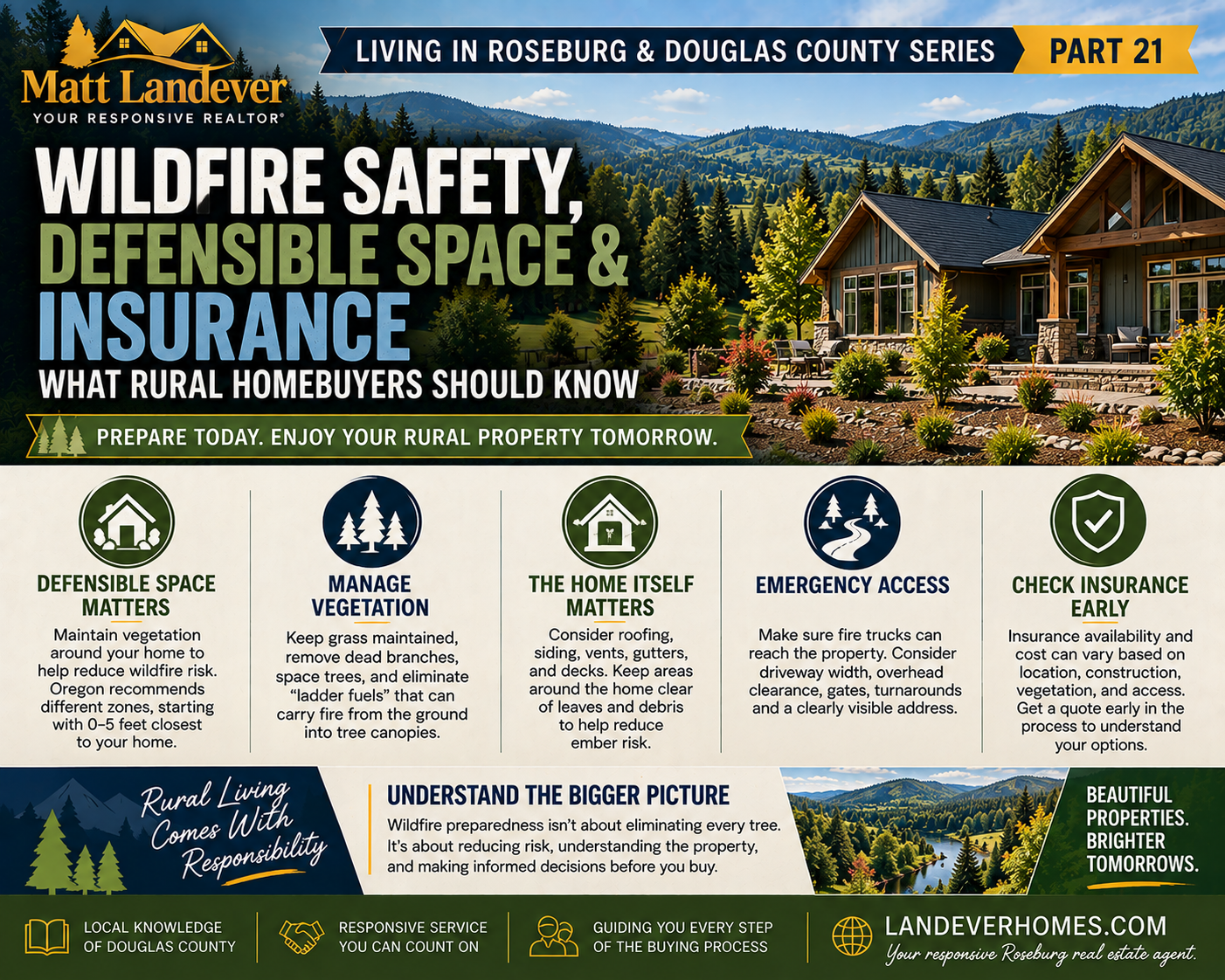
Defensible space is the area around a home where vegetation and other combustible materials are managed to help reduce wildfire risk.
Oregon's State Fire Marshal describes three primary areas around a structure: the immediate 0–5 foot zone, intermediate 5–30 foot zone, and extended 30–100+ foot zone.
This doesn't necessarily mean removing every tree and turning your acreage into an empty field.
Instead, the idea is to reduce opportunities for fire to move from surrounding vegetation toward the house.
Start Closest to the House
One of the most important areas is actually right next to the structure.
Oregon's current guidance recommends keeping the first five feet around a home relatively free of combustible materials. It also recommends keeping roofs and gutters clear of leaves and needles and removing debris from beneath decks and patios.
That means wildfire preparation isn't only about clearing acres of forest.
Sometimes relatively small improvements immediately around the house can make a meaningful difference.
Look at the Vegetation Around the Property
When touring rural homes, take a look beyond the house itself.
Are there dead branches or heavy vegetation close to the structure?
Are shrubs growing beneath larger trees?
Are grasses maintained near the home?
Are tree canopies crowded together?
Oregon's guidance recommends measures such as managing grass, spacing vegetation, pruning lower tree limbs and removing "ladder fuels" that can allow fire to move from ground vegetation into tree canopies.
These are things buyers can begin noticing even during a showing.
Don't Forget About the House Itself
Vegetation is only one part of wildfire preparedness.
Home hardening refers to making the structure itself more resistant to ignition.
Things like roofing, siding, vents, decks and the areas where debris can collect may all be worth considering.
For example, Oregon recommends screening attic and crawlspace vents with fine metal mesh to help reduce ember entry.
A property can have beautiful defensible space and still benefit from improvements to the structure itself.
Can a Fire Truck Reach the House?
This is something rural buyers don't always think about.
That long, private driveway winding through the trees might be one of the things you love about the property.
But emergency access matters too.
Driveway width, overhead tree clearance, gates, bridges, turnarounds and clearly visible addresses can all affect emergency access. The Oregon State Fire Marshal specifically includes driveway clearance and visible addressing among its wildfire-preparation recommendations.
It's another reason access matters for more than simply getting your car to the house.
Check Insurance Before You're Too Far Into the Purchase
This is a big one.
Don't wait until the last minute to investigate homeowners insurance on a rural property.
Insurers evaluate their own risk factors when deciding whether to offer coverage and what it will cost. Oregon's Division of Financial Regulation says those factors can include the home's location, construction, replacement cost, accessibility of fire protection and surrounding forest or combustible vegetation.
So two seemingly similar rural properties could potentially have very different insurance situations.
Getting an insurance quote early in the transaction can help you understand both availability and cost before you're committed to the purchase.
A Quick Note About Oregon's Wildfire Map
There's been a lot of confusion surrounding this.
Oregon's former statewide wildfire hazard map was repealed in 2025 along with the associated statewide regulatory requirements. Insurance companies also cannot use a state wildfire hazard map as the basis for increasing premiums, canceling or refusing to renew a homeowners policy. Insurers can, however, continue using their own risk models when evaluating properties.
That's an important distinction.
A buyer shouldn't assume that the old state map determines whether a particular home can be insured.
Defensible Space May Help With Insurance Too
Oregon law requires insurers to consider home-hardening and defensible-space efforts when making certain rating and underwriting decisions, although insurers have flexibility in exactly how those improvements affect their decisions.
So if a property already has good defensible space, that's worth discussing with your insurance agent.
And if it doesn't, you can begin evaluating what improvements might be practical after purchasing.
Look at the Whole Property
Wildfire preparedness shouldn't necessarily be viewed as a single yes-or-no question.
Instead, consider several pieces together:
The home. The vegetation. The driveway. The surrounding terrain. Water availability. Emergency access. And insurance.
A wooded property may need some work but otherwise be a great fit.
Another property may already have excellent defensible space and emergency access.
The important thing is knowing what you're buying.
Final Thoughts
Wildfire is part of the reality of living in many parts of Southern Oregon, but it doesn't mean you should automatically avoid rural or wooded properties.
It means wildfire preparedness belongs on the due-diligence list alongside wells, septic systems, easements, zoning and other rural-property considerations.
If you're considering acreage around Roseburg or elsewhere in Douglas County, I can help you identify these questions early and make sure you know which professionals and agencies to contact when more information is needed.
Oregon homeowners can also request a free defensible-space assessment through the Oregon State Fire Marshal
Check out this article next