Zoning, Permits & What You Can Do With Your Rural Property
When buyers start looking for acreage in Douglas County, they often have a vision for the property.
Maybe you want to build a large shop.
Maybe you want animals.
Maybe you'd eventually like to add another dwelling, divide the property, operate a business, or build something for an RV.
Having the land doesn't automatically mean you can do all of those things.
That's where zoning and land use rules become important.
What Is Zoning?
At its simplest, zoning establishes rules for how a property can be used and developed.
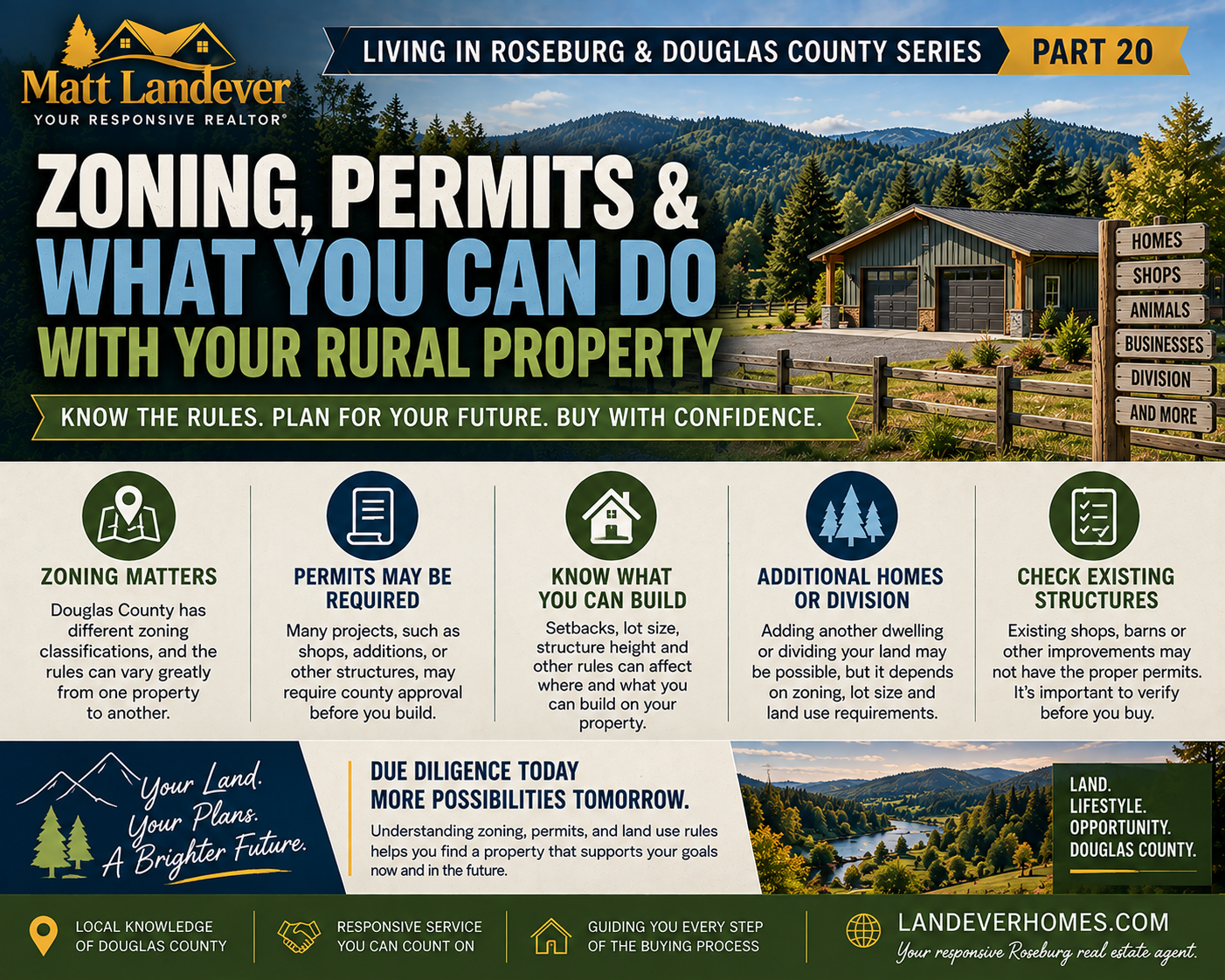
Douglas County has numerous zoning classifications, including rural residential, farm, forest and other zones. The rules that apply to one property can therefore be quite different from those applying to another.
This is especially important with acreage.
Two properties might look almost identical when you're standing in the driveway, but their zoning could allow very different uses.
"It's My Land" Doesn't Always Mean "I Can Build It"
This surprises some rural buyers.
Owning ten or twenty acres doesn't necessarily mean you can put whatever you want wherever you want.
Depending on the property and project, rules may affect things such as:
- Where structures can be located
- Setbacks from property lines
- Adding a shop, garage or other structure
- Building or placing another dwelling
- Dividing the property
- Changing how the property is used
- Development within certain overlay areas
Douglas County says planning approval is typically required before submitting permit applications to its Building Department or onsite septic program. Some projects are permitted outright, while others require additional land-use review.
What About Building a Shop?
A shop is high on the wish list for many Douglas County acreage buyers.
If that's one of your goals, don't simply look at the open space and assume you'll be able to build there.
You'll want to understand the property's zoning, required setbacks and any other development restrictions that could affect the project.
Douglas County specifically identifies new accessory structures such as sheds, shops and garages among the projects commonly reviewed through its Planning Clearance Worksheet process.
That's much better information to have before you buy rather than after you've already started planning your dream shop.
What About Adding Another Home?
This is another question I hear from buyers.
Maybe you want a second home for family. Perhaps you're thinking about a manufactured home or another dwelling sometime in the future.
This is an area where you definitely shouldn't assume that acreage automatically equals another homesite.
Whether another dwelling is allowed can depend on the zoning and characteristics of the particular property. Some proposals are relatively straightforward, while others can require a more involved land-use review.
If a second dwelling is important to your plans, it's something worth researching before purchasing the property.
Can You Divide the Land Later?
A large parcel can sometimes lead buyers to think:
"Maybe I'll split off a few acres someday."
Possibly—but don't build your purchase decision around that assumption without verifying it.
Land partitions are among the proposals that can require a formal land-use application and review in Douglas County.
Minimum parcel sizes, zoning and other requirements can affect what's possible.
If future division is part of your plan, investigate it during your due diligence.
Existing Structures Deserve Attention Too
Zoning and permits aren't only about things you want to build after purchasing.
They're also relevant to what's already there.
That beautiful shop, converted garage, addition or other improvement may raise questions about whether appropriate approvals were obtained.
It doesn't automatically mean there's a problem.
It simply means it's worth investigating rather than assuming that because a structure exists, everything associated with it was approved.
Douglas County identifies building without permits and certain zoning or setback violations among matters its code-enforcement program regulates.
Start With What You Want to Do
One of the best things an acreage buyer can do is tell me about their plans early.
Don't just tell me:
"I want five acres."
Tell me:
"I want five acres because I eventually want a large shop, chickens, an RV space and possibly another home for my parents."
That's much more useful.
Now we're not simply searching for acreage.
We're looking for acreage that has a better chance of supporting the lifestyle you actually want.
Verify Before You Buy
Real estate listings and online maps can be useful starting points, but they aren't a substitute for confirming land-use questions with the appropriate authority.
Douglas County recommends starting with its Planning Department to identify the property's zoning and determine which planning process applies to a proposed use or development.
Douglas County Planning Department
When I'm helping someone purchase rural property, part of my job is helping identify these questions early so the buyer knows what needs further investigation.
Final Thoughts
Acreage can give you incredible flexibility, privacy and room to create the property you've been imagining.
But acreage alone doesn't determine what you can do with the land.
Zoning matters. Permits matter. And your future plans matter.
Understanding those pieces before purchasing can help you find a property that doesn't just look right today, but also works for what you hope to do with it years from now.
If you're considering acreage in Roseburg or elsewhere in Douglas County, I'd be happy to help you research properties and identify the questions worth answering before you buy.
Check out this article next